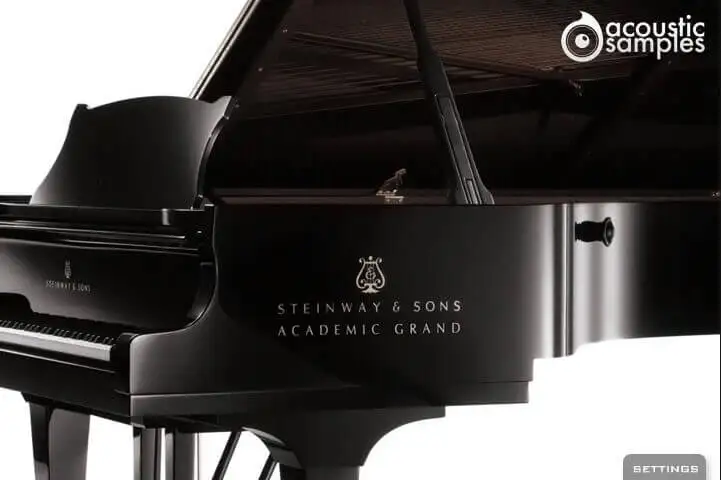

The AcademicGrand is a 1963 Steinway Model D concert grand that served for decades as the University of Arkansas' primary concert instrument, through countless recitals and concerts, inspiring hundreds of students and visitors along the way. Well maintained and cared for, it has a unique history and the classic American Steinway sound. The library was made in collaboration with Lance Herring.
Around 816 samples capture it, with 4 velocity layers for the sustain recorded both pedal up and pedal down, 4 velocities for the releases, pedal down resonance, key noises, and sustain pedal noises that are triggered automatically.
The default interface is simply the piano: every parameter has already been set the best possible way, so you can start playing straight away.
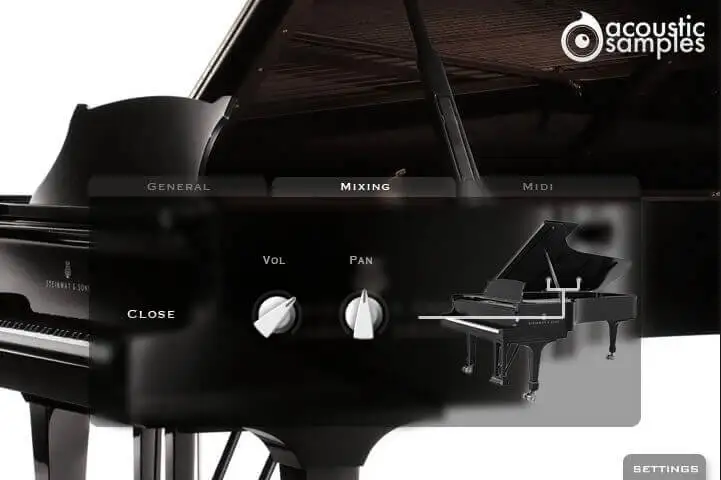
If you want to adjust something, click Settings to open three panels - General, Mixing and MIDI. On this library the Mixing panel is kept simple, with just the volume and the pan.
Mixing panel
Vol: the volume of the piano
Pan: the pan position of the piano
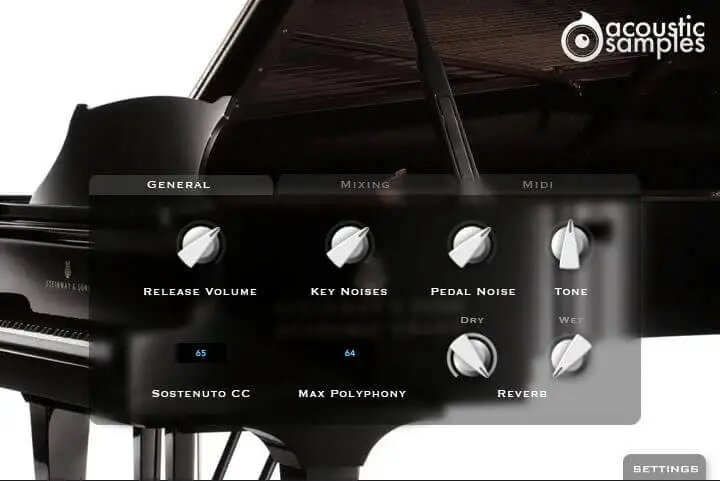
The General panel changes most aspects of the sound. The release, key and pedal noises can each be set to taste - the pedal noise in particular adds a lot to the realism.
A Tone control makes the piano brighter or darker, and a convolution reverb has separate dry and wet levels. The sostenuto pedal and the polyphony are set here too.
General panel
Release Volume: the sound produced when you release a key while a note is playing
Key Noises: the sound produced when you release a key and no corresponding sustain was playing
Pedal Noise: the sound of the pedal being pressed or released
Tone: a simple way to make the piano brighter or darker
Sostenuto CC: the controller for the sostenuto, or middle, pedal, which sustains selected notes while other notes stay unaffected
Max Polyphony: lower it to be lighter on CPU, for example with a small buffer size
Reverb: a convolution reverb, with the Dry and Wet levels set separately
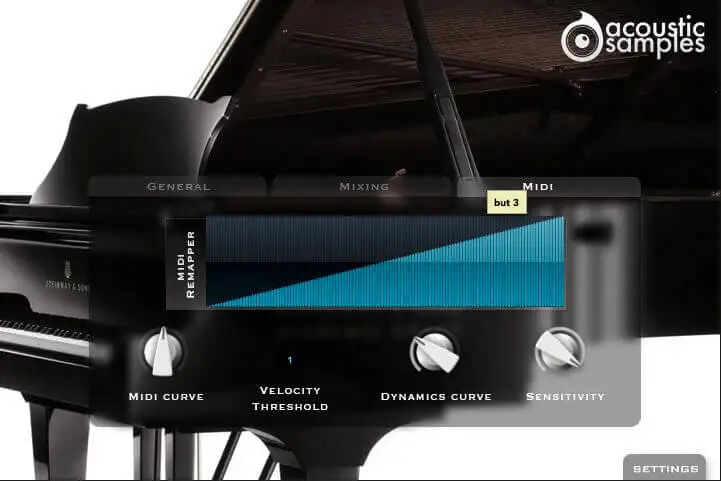
The MIDI panel adapts the library to your controller and your playing style. A MIDI remapper lets you assign any input velocity to any output velocity, and a curve shapes it.
A velocity threshold sets the minimum velocity needed to hear a note, as on a real piano, while the dynamics curve and the sensitivity set how the volume follows your playing.
MIDI panel
MIDI Remapper: assigns any input velocity to any output velocity
Midi Curve: gives the remapper a concave or convex shape, changing the MIDI sensitivity
Velocity Threshold: the minimum velocity you have to play to hear the piano, as on a real piano
Dynamics Curve: the volume curve of the library
Sensitivity: sets the minimum volume for velocity 1, from a narrow to the full dynamic range
Sample player
AcademicGrand plays in UVI Player (formerly UVI Workstation), UVI's free sample player. We provide it with every library you buy, so you don't need an expensive sampler to use our products. It works on Mac (macOS 10.14 or later, Intel or Apple silicon) and Windows (10 or later), standalone or as a plug-in (VST / VST3 / AU / AAX), in 64-bit only. More about it here.
Copy Protection
We use the iLok system to protect our products and you can choose to register your license to your computer or to an iLok dongle. If you decide to use an iLok dongle, both V1 and V2 are compatible with our products. You can activate your license on up to 3 computers or iLok dongles at the same time and you can deactivate one and activate another as many times as you want.
First time i heard this piano i was blown away . i thought this is a quality piano. i needf this one. i now am recomendind this piano to friends kids can play a quality sounding piano for practicing , recitals, performing . do you have aacadimic version for iPhone and iPad? you did an awesome job. thank you for your hard work!
This is a very good sampled piano. I have tried several others, both sampled and modeled, and this is my favorite. It requires a bit of work to adjust the weight of your master keyboard to the touch you want to obtain, but it's definitely worth it. The attack of the notes is superb, and the possibility to adjust the keyboard and pedal noises makes it very realistic. I play classical and modern music, and this piano delivers very good tone without the need to adjust EQ or add effects. I'd only like to have sympathetic resonance modeled, it would it absolutely perfect; but if you like the Steinway sound, this one beats more expensive VSTs and digital keyboards. Absolutely an excellent value for the money.
한국어 리뷰가 없네요. 구매하려고 고민중인 분들께 도움이 되고자 몆자 적어봅니다.
우선 이 아카데믹 그랜드는 스타인웨이 D-274 특유의 느낌을 그대로 잘 반영하고 있습니다. 샘플링도 굉장히 깔끔한 편이고, 고사양이나 고용량을 요구하지 않습니다.
주로 모든 장르에 써도 무방할거 같습니다. 하지만 조금 빈약한 부분이라면, 효과 (잔향, 코러스 등등) 이 살짝 아쉽습니다.
그래도 이정도 가격대에 이정도 제품이면 꽤나 가성비가 좋은 VST 같습니다. 아칸소 대학교의 1963년에 제작된 주된 연주악기라고 하네요.
As there is no one perfect piano for every application, this is a really useful virtual piano to own. It may not be as full, nuanced and dynamic as the more recent superb Acousticsamples C7, but this vintage Steinway piano tone sits very well in a mix, and maintains it clarity (which some fuller sounding virtual pianos don't) so it's a good option to have depending on the track. Great stereo imaging as well, without being artificially wide. The New York & Hamburg Steinway D's are quite different pianos, and this is great to have as a contrast to the many Hamburg D virtual pianos on the market. Highly Recommended.
http://fr.audiofanzine.com/piano-acoustique-virtuel/acousticsamples/A-PIAN/editorial/tests/touches-fran-aises.html
See the video here: http://www.youtube.com/watch?v=Q-o4zhUbeF0
We use Google Analytics to count visits and see which pages are read. Nothing else is tracked, and nothing is shared with advertisers. More about cookies.