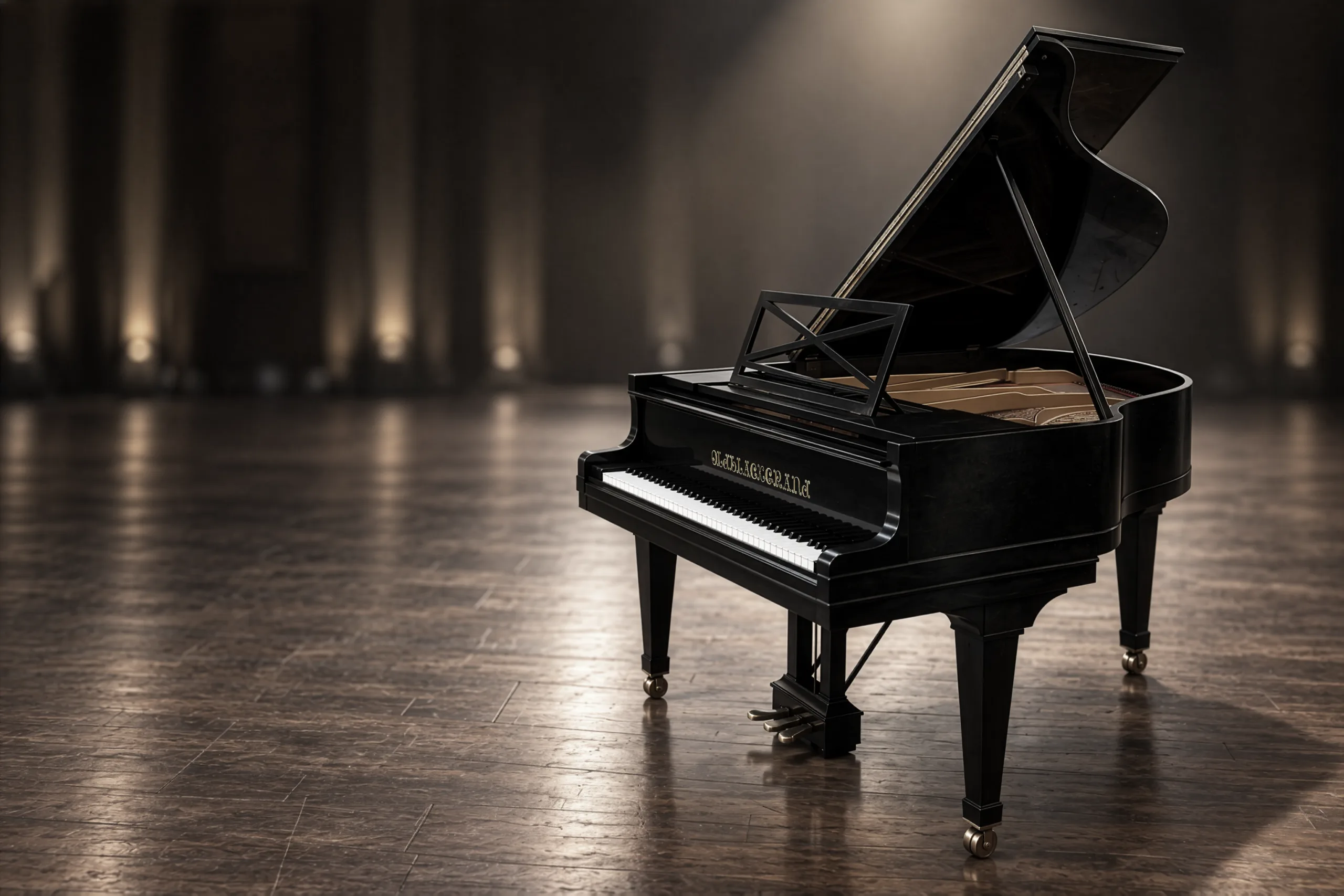
OldBlackGrand is a Pleyel grand piano, an F-71240 model built in 1928, with a warmth and depth of sound that is seldom heard in today's pianos.
We sampled it with appropriately vintage gear - a Studer console and tube microphones - from two microphone positions: around 3000 samples, with 9 velocity layers for the sustain and 9 for the release, plus key noises and sustain pedal noises.
Pleyel & Cie was founded in 1807, and its pianos were the instruments of choice for Debussy, Ravel, Stravinsky and Saint-Saens. Chopin famously called them 'non plus ultra' - pianos would never get any better than this.
If you already own dozens of virtual Steinway Bs and Ds, this is a different voice. It serves jazz just as well as the classical repertoire, particularly in the style of the golden years, and the demos are played by Jean-Michel Bernard (former composer for Ray Charles, film music composer) and Romain Collin, a French jazz pianist based in New York City.
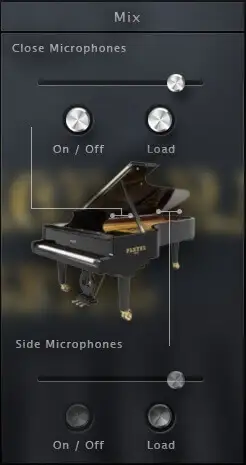
The Pleyel was recorded with two microphone positions. The close pair sits near the strings inside the piano, for deep bass and rich resonances; the side pair sits in the well of the piano and leans towards the listener's perspective.
Mix them individually to tailor the sound, or unload the one you do not use to save RAM.
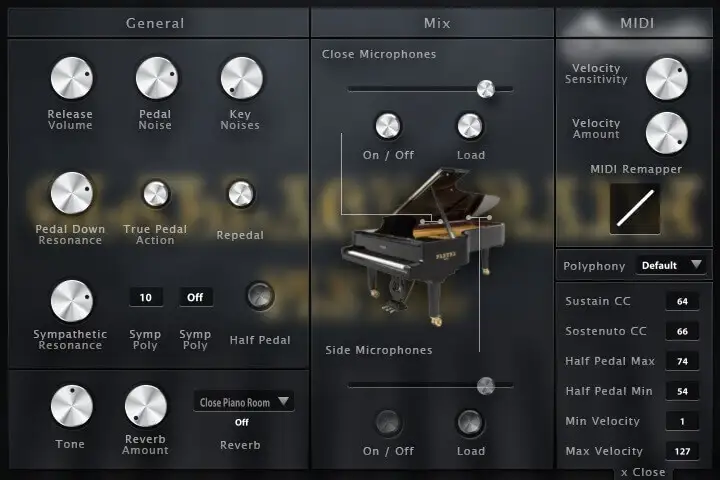
Mix
Gain: the level of each microphone position.
On / Off: enables or disables each position.
Load: loads or unloads the samples of each position. If you only use one, unload the other to save RAM; the controls are greyed out while a position is unloaded.
When all the strings of a piano start resonating, they give it a kind of natural reverb. Two resonances matter most: the pedal down resonance, and the sympathetic resonance between held notes.
Both are in OldBlackGrand and each can be adjusted on its own, including the true pedal action - the progressive resonance when you press the pedal after the chord.
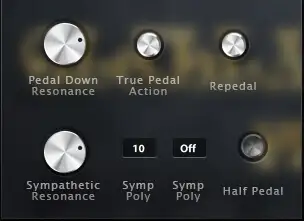
Resonance
Pedal down resonance: the amount of resonance when you press the sustain pedal.
True pedal action: the progressive resonance you hear when you hold a chord and press the pedal afterwards.
Sympathetic resonance: the volume of the sympathetic resonance between held notes. Raise it if you want the harmonics to sing out more.
Symp poly: how many voices are allowed for the sympathetic resonance.
On a real piano the pedal is not a simple on/off switch, and classical players use a range of techniques. Re-pedalling lets you catch a chord released with the pedal before its decay has ended - especially useful to blend chords together.
Half pedalling is the sound of the pedal pressed half-way: a distinct variation, with a much quicker decay in the lower register. The size of its CC zone can be set from the interface.
Half pedal
Half pedal: enables or disables the half pedal from the interface.
Half pedal min / max: the lowest and highest sustain pedal CC values of the zone where the half pedal effect happens.
OldBlackGrand is in its third version. It is very playable straight out of the box, and the preferences let you fine-tune the release volume, key and pedal noises, tone, reverb, polyphony and a software round robin.
The MIDI controls added in V3 let you set the sustain and sostenuto CCs - to use an expression pedal instead of an on/off pedal, for example - and adjust the MIDI curve, dynamics and velocity response to your keyboard and playing style.
Preferences
Release volume: the sound produced when you release a key while a note is being sustained.
Key noises: the sound produced when you release a key and no note is sustained.
Pedal noise: the sound of the pedal being pressed or released, triggered automatically.
Tone: a quick way to make the piano sound brighter or darker.
Round robin: a software round robin, to switch on for pieces with lots of repeated notes.
Polyphony: raise or lower the number of voices - lower it if you reduce the buffer or want to be lighter on CPU.
Reverb: a convolution reverb with separate dry and wet levels and a generous selection of high quality impulse responses.
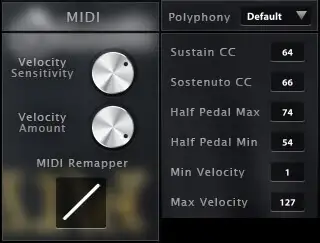
MIDI
Velocity sensitivity: shapes the volume curve, making it easier to reach the loudest layers without changing the lowest and highest volume.
Velocity amount: sets the dynamics - the minimum volume given to the lowest velocity.
MIDI remapper: sets the mapping, i.e. which velocity layer answers which input velocity.
Min and max velocity: the minimum velocity needed to make a sound and the maximum velocity that can be reached.
Sustain CC: 64 by default, can be moved to any other controller.
Sostenuto CC: 66 by default, can be moved to any other controller. The sostenuto (middle pedal) sustains only the notes held when it is pressed, while the others stay dry.

Sample player
OldBlackGrand comes with its own sample player, the UVI Workstation 3 (requires v3.1.6 or later). We provide it for free with every library that you buy, you don't need to buy an expensive sampler to use our products. It works on Mac (10.14 or later intel or arm processor) and PC (windows 10 or later), in standalone or as a plugin (VST / VST3 / AU / AAX) and in 64 bits only. You can find more info about it here.
Copy Protection
We use the iLok system to protect our products and you can choose to register your license to your computer or to an iLok dongle. If you decide to use an iLok dongle, both V1 and V2 are compatible with our products. You can activate your license on up to 3 computers or iLok dongles at the same time and you can deactivate one and activate another as many times as you want.
I am so impressed of how this sounds. The beauty of this instrument by AcousticSamples it's just irresistible. I have tons of different piano VSTs, and so far, this is my favorite one which I will use for every single application.
It's hard to believe that an old pleyel grand can sound even better than many of the famous grands out there; you don't want to believe it. But at the end of the day you say to yourself: hey, maybe this is one of those secrets that some great piano players have out there, and they don't want to tell you. I was comparing it with a piano that I hear in some great recordings, and wow this is it. Yes, this is it.
It sounds rich, sweet, big and bold. Not just that, this gives you the illusion that you are playing a real piano! You can feel the vibration of the strings inside of the soundboard, and I don't know, there's something very special with this VST.
There is something unique about the tone of a high quality piano of this vintage, that modern pianos can't capture. The aged soundboard of a handcrafted piano such as the Pleyel sampled here is a beautiful thing. This sound breathes and sings like very few other virtual pianos - you can really get lost in the music.
With all virtual pianos I own, adjusting the velocity volume, dynamics and velocity curve is essential to bring out the best tone, dynamics & responsiveness. Default settings often sound flat on my setup (Yamaha CP4 Stage), but once matched to the keyboard velocity & touch, they really open up and sound/feel much better. The Old Black Grand benefited greatly from this process, although it was much easier & quicker to find the "sweet spot" with the settings.
The upper register is stunning, and the resonances absolutely beautiful and authentic. UNIQUE and INSPIRING!
Fantastic Sounds! These samples are really top notch and blows away most workstation and sampling keyboards. Not only is this product awesome, the customer support is better than any I've ever encountered. I had a couple suggestions and an issue, they not only responded quickly, they ended up editing their program to fix the issue and added a volume adjustment tool for every key in case certain notes were strangely louder than others. Absolutely amazing.
http://fr.audiofanzine.com/piano-acoustique-virtuel/acousticsamples/A-PIAN/editorial/tests/touches-fran-aises.html
another sweet piano , I must say acousticsamples pianos are addictive, I'll be waiting for more maybe a Bechstein
We use Google Analytics to count visits and see which pages are read. Nothing else is tracked, and nothing is shared with advertisers. More about cookies.