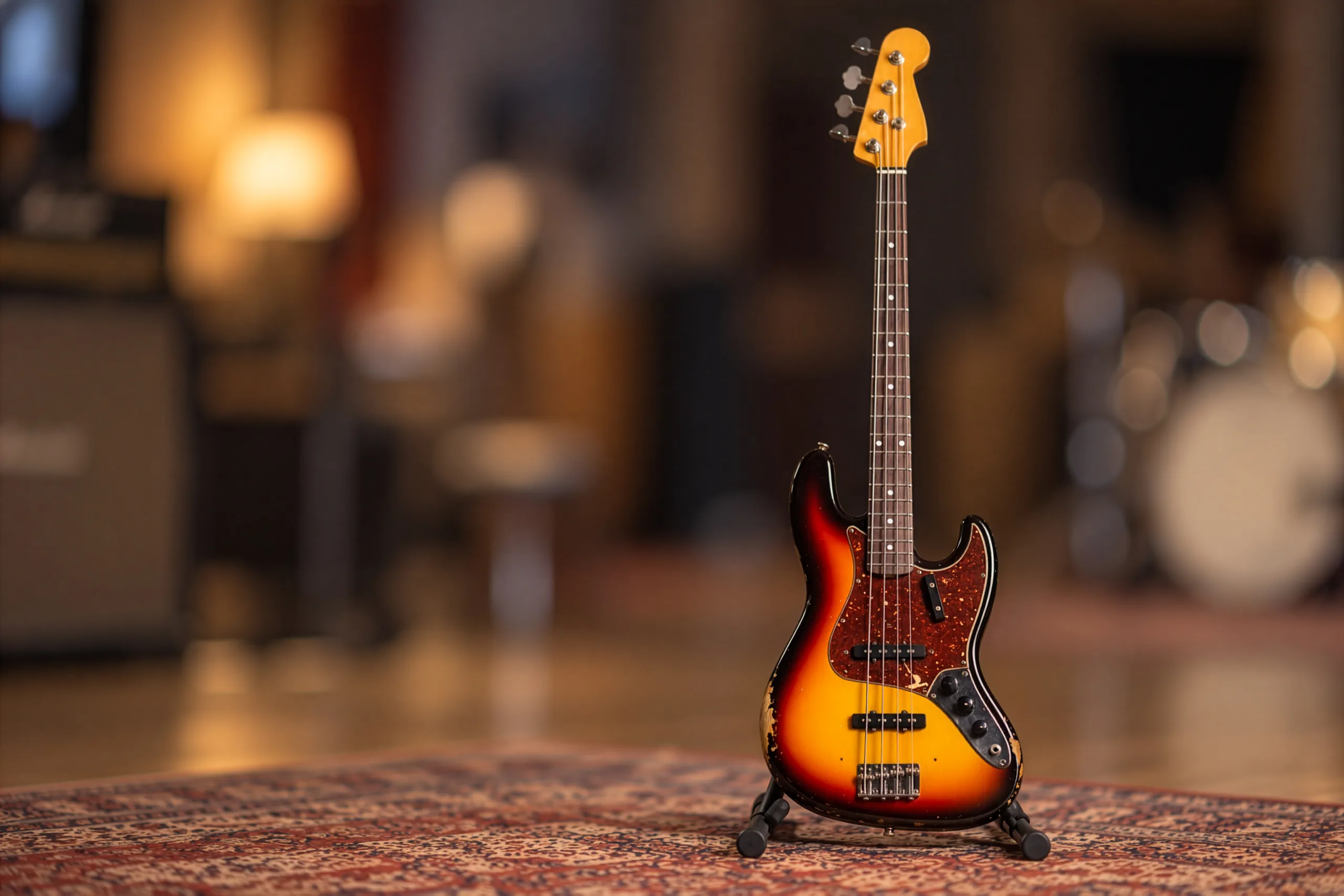
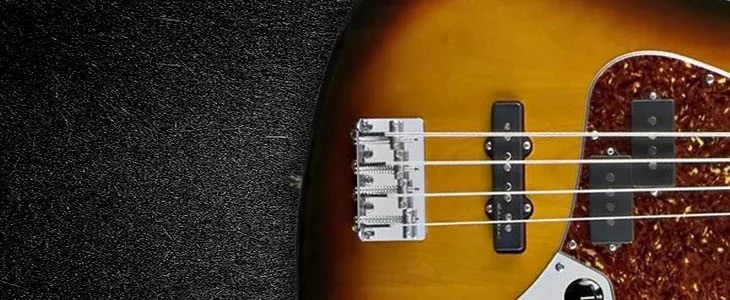
JBass is a four-string American Fender Custom Shop Jazz Bass with flatwound strings - ideal for jazz ensembles, and at home in almost any genre.
It is sampled in depth: around 2500 samples, with 6 velocity layers for the sustain, each recorded twice (2 round robins, 12 samples per note), and 15 velocities for the release.
The first Jazz Bass was made in 1960 as a companion to Fender's new Jazzmaster guitar. Its neck was longer and narrower than any earlier Fender, meant to mimic the feel of the stand-up bass, and even its new mid tones were made with jazz musicians in mind.
Its sound became fundamental to funk, disco, reggae, blues, heavy metal and jazz fusion, and is now heard in almost any genre.
The bass was recorded played with the fingers, with a pick, and palm-muted with either, and the play mode switches between them - from the panel or from the keyboard.
Play legato and JBass connects the notes with real hammer-on and slide samples. Harmonics, ghost notes and string hits are sampled too, and string noises are played randomly on top.
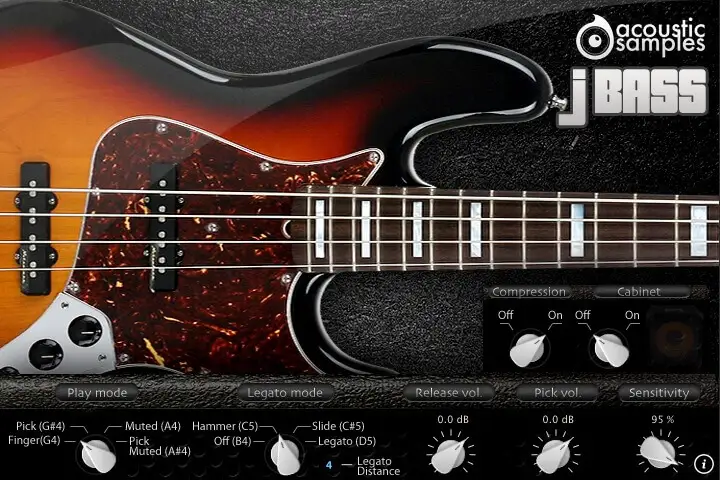
Default interface
Play mode: choose the technique: Finger (G4), Pick (G#4), Muted (A4) or Pick Muted (A#4).
Legato mode: choose whether playing legato triggers hammer-ons, slides, sustains, or has no effect: Off (B4), Hammer (C5), Slide (C#5) and Legato (D5).
Legato distance: the maximum interval over which the legato applies.
Release volume: the level of the sound produced when you release a string while a note is ringing.
Pick volume: the level of the pick, shown on the panel next to the release volume.
Sensitivity: sets the minimum volume for velocity 1, from a narrow to the full dynamic range.

A multiband compressor and a cabinet simulation can each be switched on from the front panel, with a Bass and Treble EQ to fit the bass into the mix.
The sensitivity sets how quiet the softest notes are, giving you as much or as little dynamic range as the track needs.
Front panel
Compression: turns the multiband compressor on or off.
Cabinet: turns the cabinet simulation on or off.
EQ: adjusts the Bass and Treble of the parametric EQ.
Sample player
JBass comes with its own sample player, the UVI Workstation 3 (requires v3.1.6 or later). We provide it for free with every library that you buy, you don't need to buy an expensive sampler to use our products. It works on Mac (10.14 or later intel or arm processor) and PC (windows 10 or later), in standalone or as a plugin (VST / VST3 / AU / AAX) and in 64 bits only. You can find more info about it here.
Copy Protection
We use the iLok system to protect our products and you can choose to register your license to your computer or to an iLok dongle. If you decide to use an iLok dongle, both V1 and V2 are compatible with our products. You can activate your license on up to 3 computers or iLok dongles at the same time and you can deactivate one and activate another as many times as you want.
This is really the best electric bass I've heard and used so far, with my previous favorite being the Kurzweil basses. This one maybe doesn't have all the articulations I'd look for in my "go to" instrument but, the sounds are there. The Scarbee basses sound EQ'd to be more mix-ready maybe, but to my ears they sound a bit thin. The "instrument" part of the J-Bass software is easier for me to get my head around, whereas Scarbee seemed capable but less intuitive for me. The con here is that it takes a while to load this instrument and you may end up EQ'ing it to sound like Scarbee after all.
The sound of J-Bass can just be described as great. I fell in love with this one from the first note I heard from the demos. Actually as being a bassist myself this library leaves me with some mixed feelings because it gives the premonition that in a not to distant future we will be needed less and less in the studios ;( There is even the choice between playing with pick or fingers with or without palm mute and all of these techniques just sound great! This is indeed the best bass virtual instrument I know and actually sounds better than lots of "real bass recordings" I heard and everything for a price which isn´t even comparable to a good bass. The hammer-ons and slides also sound nice and with good programming you really can give a lot of life to a bassline. The only thing that I think which could have suited this library would be some more velocity layers, especially within the low velocities for some softer articulations. Nevertheless, great job on this one!
After listening to "another one bites the dust" I immediately knew that I would get this Fender Jazz Bass sound.
It`s simply the best Fender Jazz Bass sound I ever heard.
And I heard i.e. Thomas Skarbyes J-Bass that is a very similar sounding bass sound.
Thank you acousticsamples for making these great sounds !
I appreciate.
We use Google Analytics to count visits and see which pages are read. Nothing else is tracked, and nothing is shared with advertisers. More about cookies.