JazzGuitarysm is a Gibson ES335 jazz guitar, with an optional cabinet simulation, designed for jazz ensembles of any genre.
It is sampled in depth: around 1190 samples, with 9 velocity layers for the sustain and 15 release samples per note, plus hammer-ons, ghost notes and various fret noises.
In solo mode JazzGuitarysm plays single lines the way a guitarist would: play legato and the notes are connected with real hammer-on and slide samples, with bends on the pitch bend wheel and/or aftertouch.
The legato mode decides what an overlapping note does - hammer-on, slide, plain sustain or nothing - and the legato distance sets the widest interval it applies to.
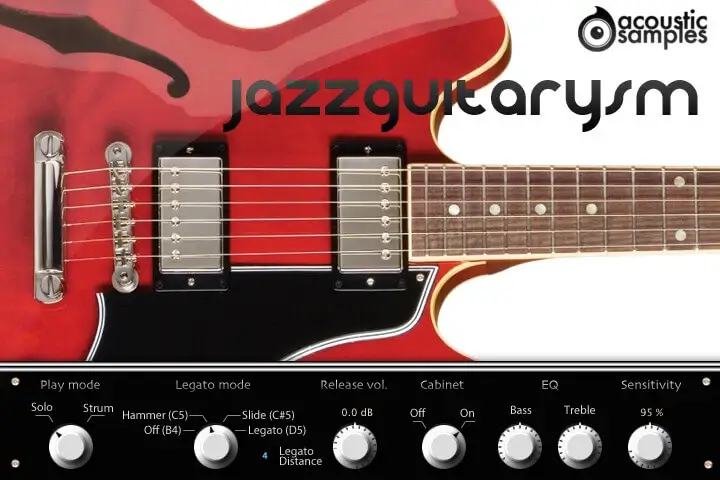
Default interface
Play mode: choose between the solo mode and the strum mode.
Legato mode: choose whether playing legato triggers hammer-ons, slides, sustains, or has no effect. The keyswitches are shown on the panel: Off (B4), Hammer (C5), Slide (C#5) and Legato (D5).
Legato distance: the maximum interval over which the legato applies.
Release volume: the level of the sound produced when you release a string while a note is ringing.
Cabinet: turns the cabinet simulation on or off.
EQ: adjusts the Bass and Treble of the parametric EQ.
Sensitivity: sets the minimum volume for velocity 1, from a narrow to the full dynamic range.

Switch to strum mode and the engine recognises the chord you play and strums it like a guitarist, from a smart strumming technique rather than a simple arpeggio - ideal for comping.
Piano mode strums the chord as soon as you play it. Guitar mode lets you hold the chord and strum it down and up from two keys, or pick the strings one by one - a little harder to play, but more realistic.
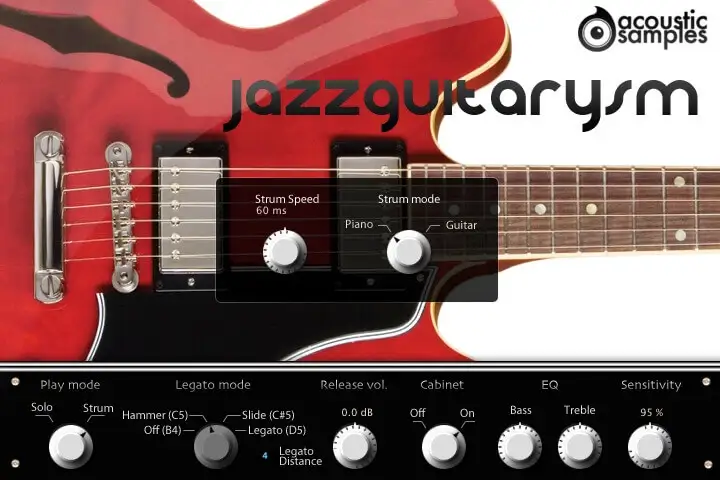
Strumming interface
The strumming interface has the same controls as the default one, plus:
Strum speed: the speed of the automatic strums.
Strum mode: choose between the Piano and Guitar modes.
Piano mode: play a chord and the engine recognises it and strums it right away; replay any note of the chord to strum it again.
Guitar mode: the chord you hold only defines what will be played: press C5 to strum it down, D5 to strum it up, or the notes above to play the strings one by one, for arpeggios for example. A little less easy to play, but more realistic.
A Fender Frontman 212R cabinet simulation, which you can switch off, and an EQ with the same parameters as on the real guitar are on the front panel.
Every parameter, like the strum speed or the play modes, can be driven from any controller, so everything can be automated.
Sample player
JazzGuitarysm plays in UVI Player (formerly UVI Workstation), UVI's free sample player. We provide it with every library you buy, so you don't need an expensive sampler to use our products. It works on Mac (macOS 10.14 or later, Intel or Apple silicon) and Windows (10 or later), standalone or as a plug-in (VST / VST3 / AU / AAX), in 64-bit only. More about it here.
Copy Protection
We use the iLok system to protect our products and you can choose to register your license to your computer or to an iLok dongle. If you decide to use an iLok dongle, both V1 and V2 are compatible with our products. You can activate your license on up to 3 computers or iLok dongles at the same time and you can deactivate one and activate another as many times as you want.
Got this plugin during the sale over the holidays, sounds great!
To get the most out of this plugin I would recommend a good guitar effects processor and amp modeler.
For clean sounds, it is decent. You can get some super solid rhythm sounds out of this, especially with voicing "strum" feature that helps find good voicings for guitar players (voicing feature is also helpful if you plan on using this to write guitar parts for live guitar players). Although, getting some built-in strumming patterns similar to the Ample Sound instruments would be nice.
Lead stuff can be a bit tricky as it's difficult to emulate human feel and articulations on a keyboard or in a DAW, regardless of the instrument plugin. But, if you use a good amp sim with effects and spend some time messing with the velocities of the instrument itself you can get decent results.
As someone who loves and writes music in genres that use the guitar; however, doesn't play guitar themselves, this plugin has been very useful.
Well worth the money!
Great sound (though could have done with some lower-line-movement on the 'drop2' chords in Giant Steps !!).
I bought this Jazz Guitar sound although I have the
Andrea Pettinato Jazz Guitar sound already.
This thing is simply the best Jazz Guitar sound out there right now.
The UVI engine it comes with makes a rocksteady-programmed impression,
the loading time is acceptable and the sound very musical and likeable.
Having the politics to only buy sounds I would be able to use in EVERY
song I write, design or compose
this jazz guitar sound is one of the very few sounds I cant live without
and will never regret of having bought it.
A no-brainer as I`d like to call it.
Perfect for Jazz, Blues, RnB, Funk, Soul, Gospel and Lounge music.
We use Google Analytics to count visits and see which pages are read. Nothing else is tracked, and nothing is shared with advertisers. More about cookies.